Before a single card was designed, Lily and James were given two complete
worlds their wedding could live inside — and asked to choose one.
Direction AThe Field Study
Direction BThe Ranch Sky
ChosenA
Where it started
Lily and James were married on a working ranch in Gillespie County, under the same
live oak grove where he proposed — and where, for twenty long minutes, the ring was
lost in the grass.
They did not want a Texas wedding. They wanted this wedding: one particular
county, one particular October, one particular grove. So neither world we built was a
style. Each was an argument about which part of that afternoon the stationery should
be made of.
“This is the land that makes sense to us.”
Direction A
The Field Study
A
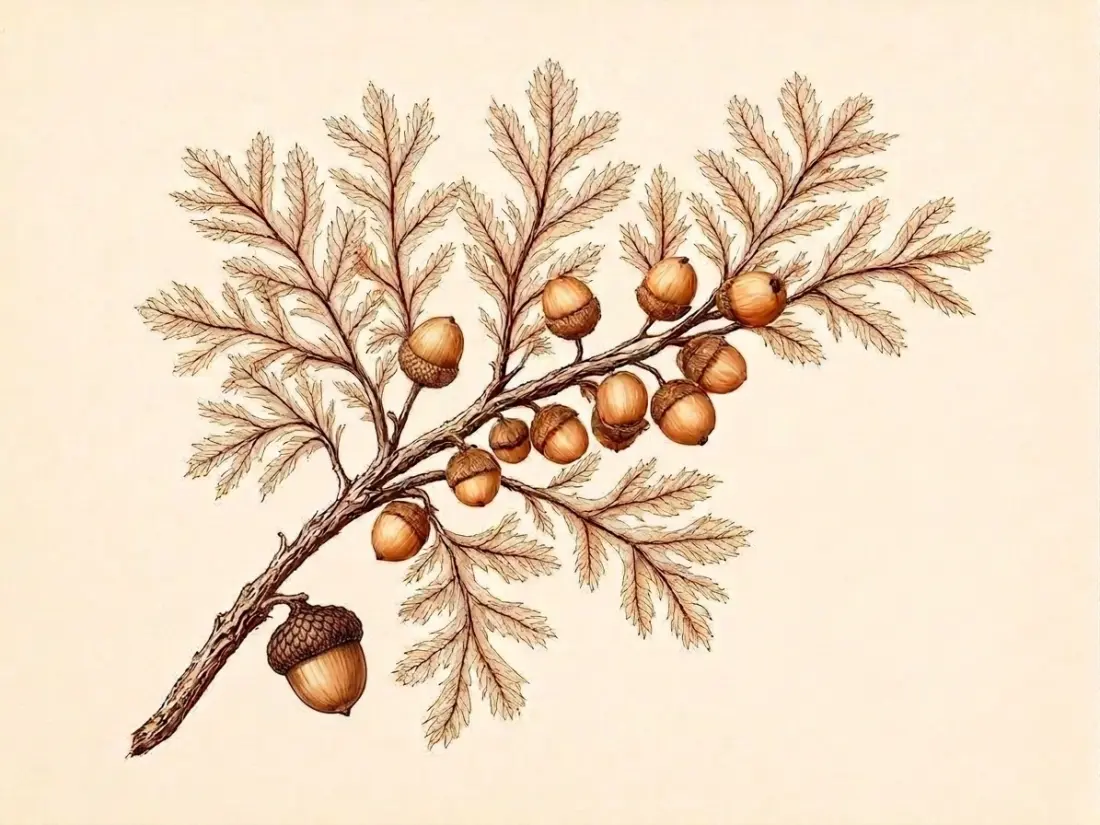
A naturalist's record of a specific place. The suite is treated as a specimen plate:
the live oak drawn with the documentary care a field scientist would bring to
Quercus fusiformis — not decorative, not impressionistic, but precisely
this tree on this ranch.
Sp. No. 24 · Quercus fusiformis
Terracotta
#C4956A
Hero warmth · rules · specimen labels
Linen
#E8DFD0
The paper ground, always
Dark Pecan
#3D2B1F
Primary ink · the deep anchor
Warm Tan
#8B7355
Secondary text · venue lines
Turquoise
#4E8D8D
One thread only — the grandfather's stone
Limestone
#D4C9B5
Texture wash · borders
Display · Playfair Display
Lily & James
Body · EB Garamond · and the specimen tag in Courier
Saturday, the twenty-fourth of October, two thousand and twenty-six, at five o'clock in
the afternoon. Contigo Ranch, Fredericksburg, Texas.
Sp. No. 24 · Oct. MMXXVI · Gillespie County, Texas
✕ Floral maximalism or garden-party styling
✕ Rustic wood-grain texture
✕ Script or calligraphy faces
✕ Millennial blush and dusty rose
✕ Horseshoes, boots and other western icons
✕ Gradients or modern minimalism
What this world had still to settle
Whether one named tree can be drawn precisely enough to be that tree. Documentary care applied to this oak on this ranch is the claim, and a drawing accurate to the species is not the same as accurate to the specimen.
Whether a specimen plate can carry a wedding. Not decorative and not impressionistic leaves very little warmth on a piece whose job is to invite people to a celebration.
Whether the Latin name appears on the paper. It is the device that makes this a field study, and it is also a botanical term on a wedding invitation.
Whether the record has room for two people. The subject of this world is a tree, and the couple currently sit wherever the plate leaves space.
Direction B
The Ranch Sky
B
The same county, taken the other way. Here the land is the protagonist — horizontal,
vast, warm at golden hour. The oak stops being a specimen and becomes a silhouette;
the invitation turns landscape; the type is set monumentally, as if branded onto the
ground rather than drawn on paper.
The oak as one formThe single cool noteGillespie County · the hour before the ceremony
Terracotta
#C4956A
Golden hour · the dominant warmth
October Sky
#B8C4C4
The muted blue-grey above the ridge
Dark Pecan
#3D2B1F
The silhouette · ground and ink both
Limestone
#D4C9B5
Dry grass · the pale middle distance
Turquoise
#4E8D8D
One carved geometric accent, set like silver
Display · Playfair Display 900, tracked wide
CONTIGO RANCH
Body · EB Garamond, set sparely against the image
Lily & James · the twenty-fourth of October · five in the afternoon
✕ Botanical specimen drawing
✕ Portrait cards and centred symmetry
✕ Small ornamental detail of any kind
✕ Script or calligraphy faces
✕ Sunset-postcard saturation
✕ Horseshoes, boots and other western icons
What this world had still to settle
Whether monumental type can be set on a landscape sheet nine times. Branded onto the ground rather than drawn on paper is the ambition, and most pieces in a suite are small and portrait.
Whether the oak survives becoming a silhouette. It stops being a specimen — which is the point, and also the moment it becomes a shape any oak could make.
Whether golden hour can be the only light. Warm and vast at one hour is the world; the ceremony, the table and the post all happen under different light.
Whether the single cool note is enough relief. One cool value against terracotta and gold is the whole of the balance, and it has not been tested at signage scale.
The decision, as they saw it
Drawn, or photographed.
A · The Field StudyB · The Ranch Sky
Both worlds share one county, one palette family and one turquoise thread. What separates
them is where the beauty is kept: in World A it is held in the hand and examined; in World
B it is standing out in the field, half a mile away, at the wrong time of day to photograph
properly — which is exactly why it is beautiful.
Direction A · Chosen
They kept the specimen plate.
The Whitfields chose The Field Study — the world that could be held, catalogued and
kept, with the October sky surviving as a single turquoise note rather than the whole
ground. Nine pieces were built from it.