The Delivered Suite · 2026
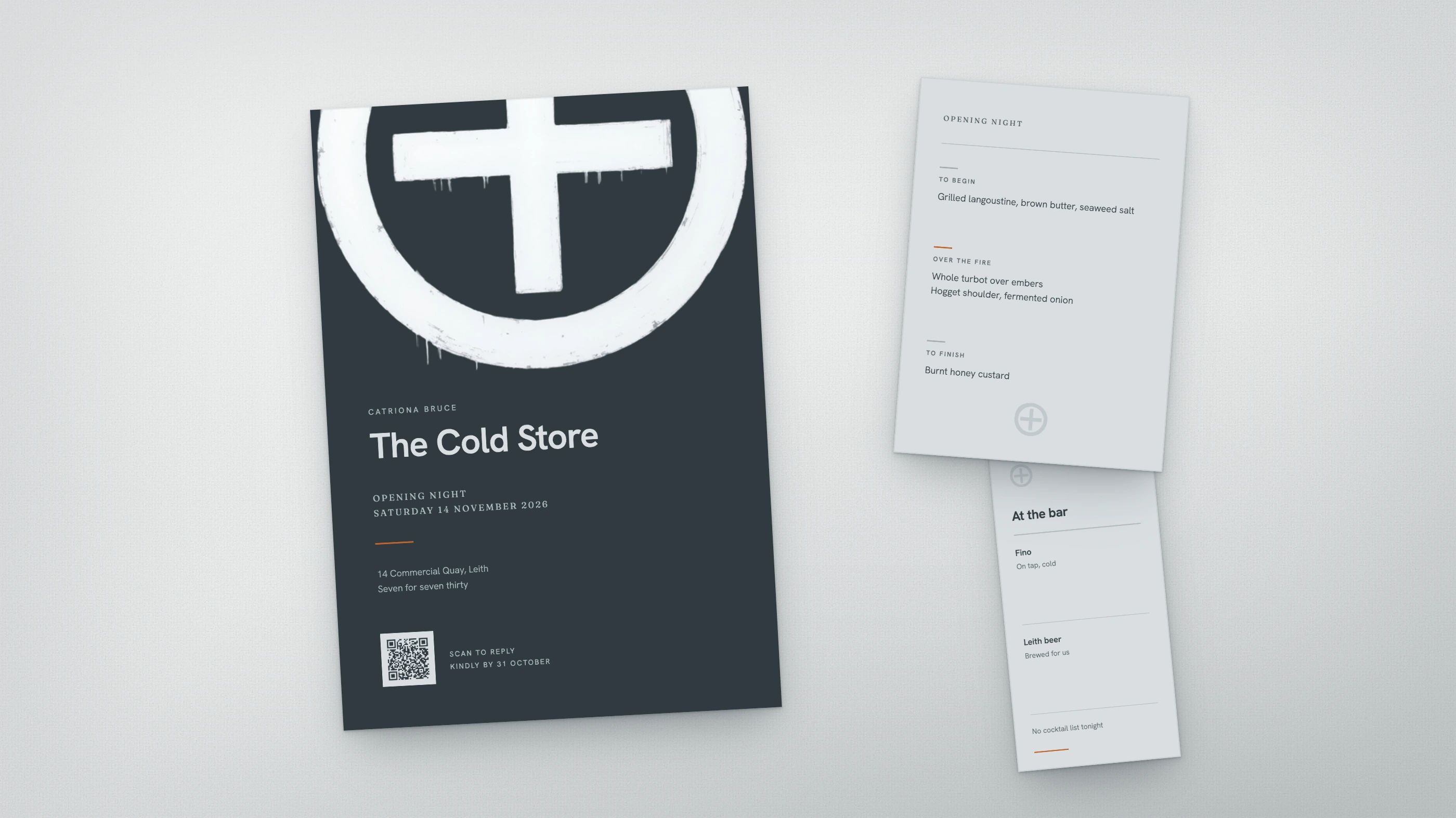
Sp. No. 01 · 02 · 03 · Invitation, Menu card, Bar and drink menu
CP
Opening Night
The Cold StoreThe Painted Mark
Seven pieces · Two carry a name
Seven pieces · Two carry a name
Every piece below is the delivered artwork, not a mock-up of it. The panel is live: put a name in it and watch each piece that carries a name take it, exactly as it does in a real print run.
The pieces that read the same for the whole room carry no name at all — and we say so.
Not decoration — every one of these has a job, and they are the same inks the pieces below are printed in.
Aa
Aa
Hanken Grotesk leads every piece; Fraunces appears only as tracked-caps support lines. Lining numerals throughout — the industrial register.
Opaque white screen print, double hit, on ice board. The same mark blind-debossed on the zinc pieces. No foil, no die-cut, no liner — flat working pieces, the hospitality register. Print files as PDF/X‑4.
A direction is as much what it turns down. This list was written when The Painted Mark was chosen, and every piece below holds to it.
The master object, and the only piece where the mark is cropped by the trim on three sides at once — it is allowed to run off, and the crop is what makes it read as found rather than placed.
This piece already carried a guest's name — it shipped showing real ones. The platform simply sets each guest's own.
{{GUEST_NAME}}
Each guest's own code — live, and it scans. It is not printed on this delivered design; it belongs to the reply card and the badge.
A working piece, so it keeps the zinc board. Three courses, named for what actually happens to them — to begin, over the fire, to finish — and the dish and nothing else, which was the client’s instruction on voice.
It reads the same for the whole room, so it prints once.
no placeholders
A narrow card with the mark at the head, blind. The fino on tap and the Leith beer brewed for the room are given exactly equal weight.
It reads the same for the whole room, so it prints once.
no placeholders
No board and no frame — the same white, stencilled straight onto the brick, in the technique the door was marked with.
It reads the same for the whole room, so it prints once.
no placeholders
The mark at a quarter size beside the name — which is what this piece has always been described as doing, and what it did not do: it sat in the top corner with twenty millimetres of empty board between it and the name, on a card only sixty-four millimetres tall. A horizontal lockup closes that gap and reads as one object.
This piece already carried a guest's name — it shipped showing real ones. The platform simply sets each guest's own.
{{GUEST_NAME}}
The only pieces that drop the mark completely: at this size, the system says, only the type survives. They run on ice rather than zinc because a table card is the one thing in the suite read across a room instead of in the hand — that is the signage job, so it sits in the signage register, and the place card lying flat beside it stays zinc.
It reads the same for the whole room, so it prints once.
no placeholders
The only pieces that drop the mark completely: at this size, the system says, only the type survives. They run on ice rather than zinc because a table card is the one thing in the suite read across a room instead of in the hand — that is the signage job, so it sits in the signage register, and the place card lying flat beside it stays zinc.
It reads the same for the whole room, so it prints once.
no placeholders
Every impression below is the same delivered file — The Cold Store place card — with a different guest's name set into it, exactly as it comes off a real run. Not a mock-up: it is the piece shown above, personalised by the same code. The names are examples.
12 guests shown across 12 sheets. A real list simply continues — one run, one file per guest.
At the guest's own link the platform renders The Cold Store invitation — this file, not a separate digital version — and draws a reply panel into it. On the left, as it prints: the container is empty and collapses. On the right, as it opens.
The panel is injected by the platform, not drawn by the design — which is why the delivered file declares only the empty container, and why the printed card carries no trace of it.
Each of the seven designs above becomes a personalised, print-ready file for every guest on the list — at the true trim size, with the backgrounds and the fonts the printer expects.
Two of the seven pieces carry a name. The rest read the same for the whole room, so they print once — and each one says so.
Each guest's own code opens their own page. The same code, read at the door on opening night, marks them arrived — so the room knows who is in it without anyone standing at the entrance with a list.
Change the table in the panel above and the card takes it. The chart in the portal is drawn from that same list, so moving a guest is a change of one field, not a new piece of artwork.
The same card, at the same guest’s link, with a reply panel drawn into it. Not a separate digital version in a different style — the design itself, continued. It is further down this page, in both of its states.